A short story by A/P Philip Holden. Situated mainly in Singapore, it explores issues of transnationalism and postcolonialism among other concerns. (via Lucas)
Tag - writing
Well, I’ve been thinking about this for a while – since August 2008 to be precise, after the reviews for OTOT came out. So I guess now is as good a time as any to talk about it.
To contextualise things slightly: the general opinion of Something Old hasn’t been very positive. From a personal standpoint, I agree wholeheartedly – while the premise of the play was intriguing, the way I handled the dialogue, drama and action left much to be desired.
So I’m cool with it if reviews say the play was poorly written. For one, everyone is entitled to their opinion; for another, I am my worst critic, in more ways than one: I am self-aware enough to recognise when something did not work. In the case of Something Old, it worked, but it could’ve worked better if I hadn’t been so heavy-handed with the writing.
But back to the point about reviews. What I want to question is: what is the relevance and value of a review, if the review merely says a particular piece of art was bad? (Sidenote: Students might want to approach this from the classroom perspective e.g. when you say a teacher can’t teach well.)
I think reviews – regardless of what is being reviewed – should have some relevance and value. One might argue that a review’s relevance and value is in informing the general public if a production is worth watching or a book is worth buying, etc. That makes sense: people neither want to waste their money on bad theatre nor do they want to waste money on bad books, or bad education, and so on.
But on the other hand, where is the sustainability in that? With some hindsight any artist worth her salt will recognise when a piece of art is shite. Being told that the art is shite doesn’t make the art any better, but only serves to make the artist feel crappy too. Save the stereotype of the artist as having a sensitive soul, most people are human, and if I may take this opportunity to add: not kind words from friends cut deeper than stones from strangers do.
So: here’s The Laremy Challenge (cheh…). For anyone who’s reading this – bloggers, journos, winos, blogger-journos, journo-winos and the like – I’d like you to keep the idea of sustainability in mind when you next write a review about something.
If that something sucked – be frank. Say it sucked. But say it in a sustainable fashion. Say it sucked nicely and then say how it sucked, and what could’ve been done to stop it from sucking so much e.g. if the piece had been written this way, or if it had been painted that way, etc.
I think if you try this, you might find your review still sells. People will want to read you so long as you write well, and any writer worth her salt will know how well s/he writes after a bit of hindsight.
But what’s more important is that the art you create is going to help someone else become a better artist. At the very least, you might realise that creating good art, in all senses of the adjective, isn’t so easy after all.

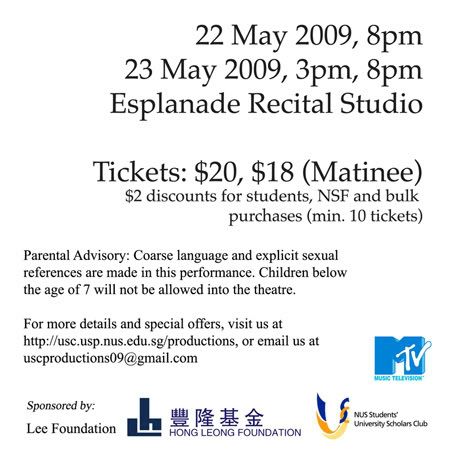
Something Old, Something New, Something Borrowed, Something Blue is a quadruple-bill presented by the NUS University Scholars Club (USC). This year’s production is directed by Leonard Augustine Choo, and features plays written by Christine Chong, Lucas Ho and Laremy Lee.
Date: Fri, 22 May 2009 – Sat, 23 May 2009.
Time: 8pm (Fri and Sat); 3pm matinee (Sat).
Venue: Esplanade Recital Studio.
Tickets: $20, $18 (Matinee).
$2 Discounts for students, NSFs and bulk purchases (min. 10 tickets)
Parental Advisory: Coarse language and explicit sexual references are made in this performance. Children below the age of seven (7) will not be allowed into the theatre.
For more details and special offers, visit the Facebook Event Listing, the production website or drop the club an email.
Join us and our talented cast for tears, laughter and everything in between. Welcome to the wedding of the year.
I’ve contributed a 20-minute play to the production, no-strings attached. Sort of like my way of saying thanks to the USP (University Scholars Programme) and the USC. You can read the latest revision here if you like, or read the blurb below:
 |
Something Old By Laremy Lee The aisle has been swept, the guests are seated, and the ceremony is about to begin. But just when everything seems to be going according to plan, two uninvited guests arrive. Benjamin, the groom, must explain as best he can why he has not invited these two guests – a particularly difficult task, given that they are his own parents. |
Hope to see you there! 🙂